

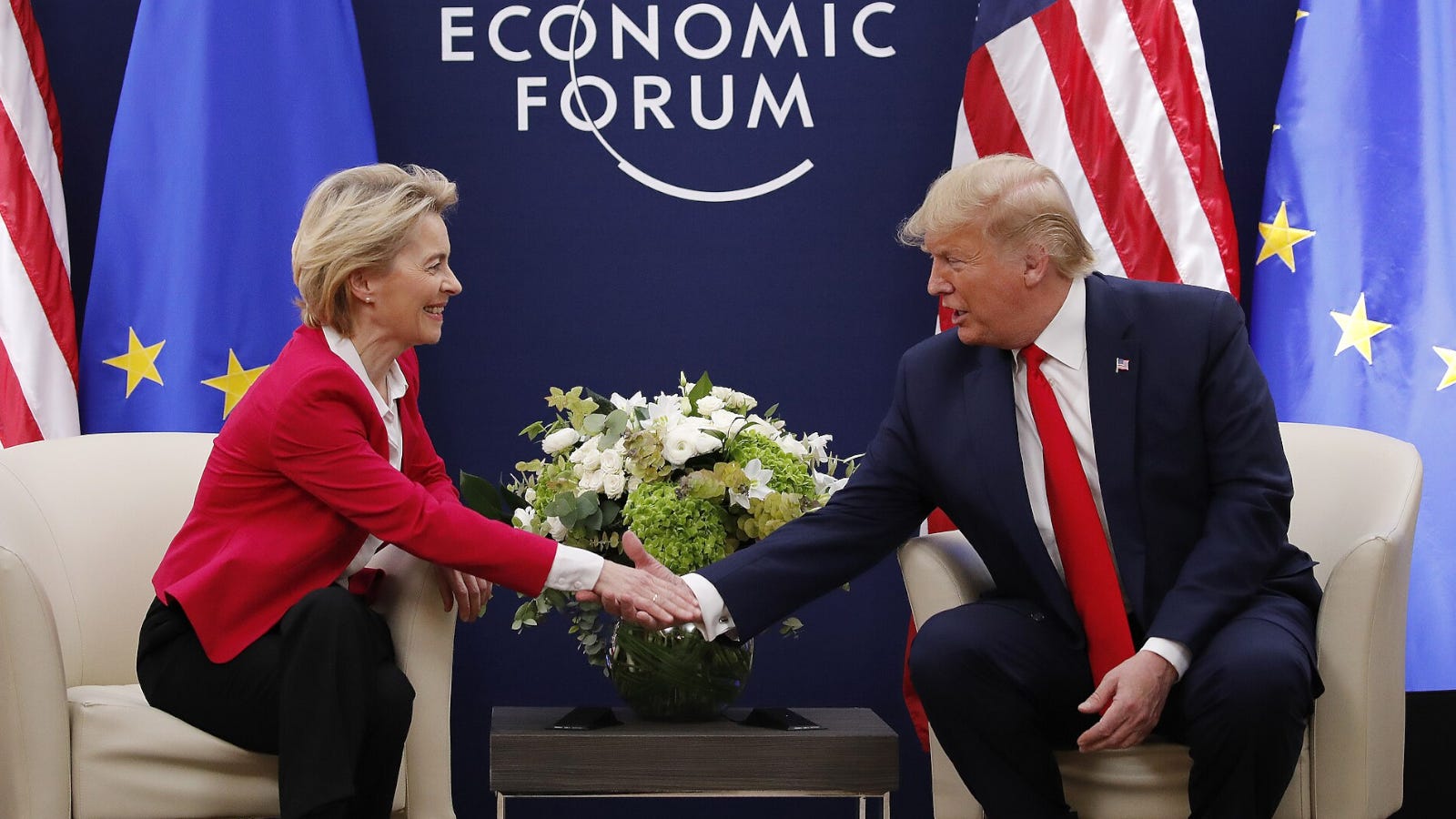
European integration is divisive above all because, since 1945, we have lived in a Europe united under American hegemony. The political architecture of Western Europe, which was extended eastward following the collapse of the Soviet Union, rests on two pillars: American security guarantees within the framework of NATO and economic integration through the European Union. The two belong together. This is why far-sighted American statesmen have always supported European integration. Far from creating an independent pole, the common representation of the economic interests of the periphery stabilizes the American Empire.
On economic policy matters, the EU provides a single interlocutor and negotiating partner instead of three dozen. Less far-sighted US politicians, including the sitting president, would certainly prefer otherwise, since they would then have greater leverage in individual negotiations. But, first, it is not in an empire’s interest for the center to bleed the periphery dry. Few things are more destabilizing than that. Second, three dozen different import-export regulations would hardly be conducive to the interests of American companies either.
The EU is, first and foremost, the political participation of the peripheral states in the American Empire. Nothing makes this clearer than Canada’s rapprochement with the EU, to the point that even the possibility of joining has been considered. If the European Union contained even the nucleus of geopolitical autonomy, this would be far more dangerous than Ukraine’s attempt to break out of the Russian orbit. The policy of Canadian Prime Minister Mark Carney makes sense only on the premise that European independence is not even hypothetically on the table. Under those circumstances, however, it is entirely reasonable for Canada to join the largest organization representing the interests of American vassal states.
Such an organization representing the interests of vassal states is perfectly appropriate and sensible for an empire. The reason we fail to recognize the EU as such is that, having emerged from an era of unrestrained nation-state sovereignty, we no longer understand the political forms of an empire or a realm. How else can we explain the common use of the term “vassal state,” usually intended to mean that such a state is a slave of the United States of America? The vassal, that is, a political entity with limited sovereignty and complex, situationally dependent relationships, is not a familiar concept to us.
The twin pillars of the security order are therefore NATO and the EU, with NATO being, so to speak, the firstborn twin. Through economic security and integration, the EU serves to stabilize the transatlantic alliance. The British were able to leave the EU without much changing for them in terms of security policy. And that is why the economic consequences, despite all the doomsday predictions, remained limited. Even though some EU grandees would have liked to punish the British and tried to do so to some extent during the Brexit negotiations, subjecting such an important NATO member as Great Britain to a trade war or even sanctions was simply not practical.
A German withdrawal from the EU would entail considerably greater friction because of Germany’s central role within the Union. But even that pales in comparison with the earthquake that would shake Europe if Germany were to leave NATO and actually pursue an independent national defense and security policy. For the most important guarantee provided by the United States is not against Russia, but a guarantee that European states will be protected from one another. As an extraregional hegemon, the United States, by virtue of its sheer size, overshadowed the established European great powers and broke the geopolitical law that had previously governed Europe: that this continent, unlike, for example, the Chinese geopolitical sphere, cannot be unified.
The Roman Empire, to which,in a subtle historical irony, the most diverse attempts to unite Europe under a single banner appealed for almost a millennium, was not a unification of Europe but of the Mediterranean world. The fundamental prerequisite of this empire was maritime transport across the Mediterranean, and its attempt to unite Europe came to an end at the Battle of the Teutoburg Forest, where, along the tributaries of the Rhine, the final outposts of this logistical network reached their natural limit.
A mere glance at a relief map of Europe reveals the British Isles and the Iberian and Italian peninsulas. Scandinavia in the north is cut off from the rest. In the center of the continent rise the Alps, dividing it not only along a north-south axis but also east-west. Has anyone ever considered what it means for a continent’s capacity for unification when, at its very center, there is a small state that, thanks to the grace of its geological formations, was able simply to declare itself neutral for centuries? Even at a time when the two rival great powers of Europe, the Habsburgs and the Bourbons, were separated in a straight line by Switzerland alone?
To the east lies Russia, with which every attempt at European unification since Napoleon has amounted to a zero-sum game in terms of security policy.
[For the second part, please subscribe to Fragen zur Zeit. A full subscription costs just €7 per month, and you no longer need a credit card. I am adding this note here separately because people keep coming to me assuming that, just because I do not put the paywall after the first five lines, the text must be over.]

