

Of all the political thinkers in history, none got the timing quite as wrong as Robert Filmer. His Patriarcha is the political retrospective of the agrarian age.
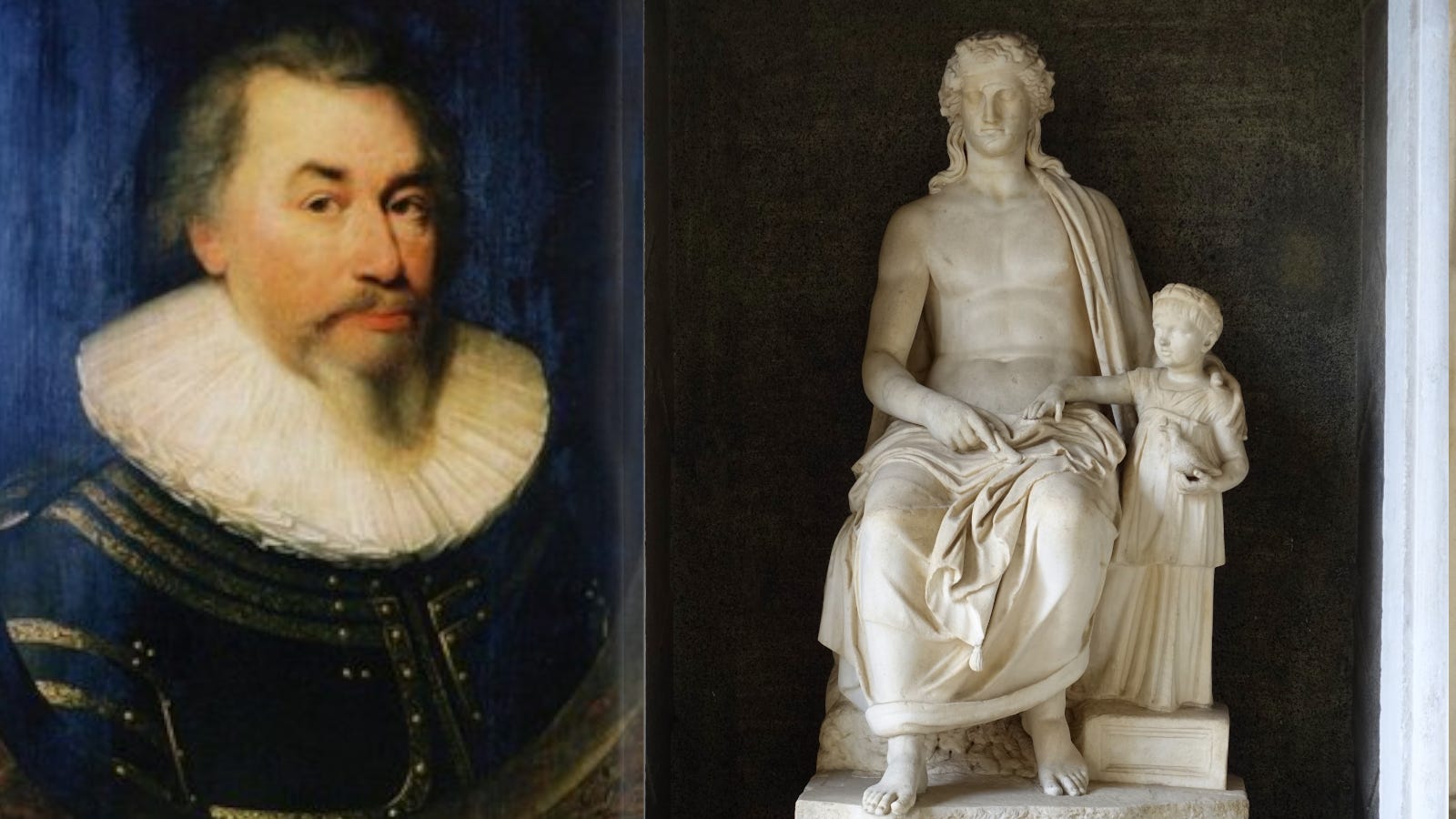
(Montage: Fragen zur Zeit; Robert Filmer: Tomitoch, CC BY-SA 4.0, via Wikimedia Commons; Roman Pater Familias with son: Daderot, Public domain, via Wikimedia Commons)
Today, Robert Filmer is known almost exclusively because John Locke devoted himself to attacking him in the first of the Two Treatises of Government. Or, more precisely, to attacking the straw man he constructed in place of Robert Filmer.
John Locke’s Robert Filmer is an obscurantist who, hurling Bible verses about, condemns humanity to eternal slavery. According to Locke, Filmer’s theory is this: When Adam was created, he was granted unlimited dominion over the earth, including dominion over his own descendants. This dominion was then passed on to some of his sons, though for some reason not to others, and so it was handed down through the generations, meaning that the kings of the present day derive the legitimacy of their rule from this original paternal authority of Adam.
This is so far removed from Robert Filmer that taking the first of Locke’s two treatises seriously amounts to repeating, page after page, that Locke is arguing entirely past Filmer. And yet Locke quotes Filmer extensively, passage by passage. Either Locke did not understand Filmer, or else he understood him all too well.
Nevertheless, it is illuminating to examine how Locke tries to get at Filmer. Locke attempts to refute Filmer according to the social-contract theories of his time. These were not simply the fiction that at some point everyone had somehow agreed to a particular form of government. They were an attempt to construct a political community juridically from the assumption of natural law, through transfers of rights. The idea was this: In the state of nature, man possesses certain rights by virtue of natural law, and these rights can be transferred. Thus the political community comes into being. These transfers of rights must then be examined in much the same way lawyers are still taught to examine them today. Did the person possess the right he purported to transfer in the first place? Was he legally entitled to transfer it? And did he actually transfer it?
In his second treatise, for example, Locke denies the possibility of lawfully transferring the disposal of one’s own life and liberty to another. Thus, for Locke, the death penalty and slavery are not constructed from a transfer of rights by those subjected to them, but through the transfer, by the other members of society, of everyone’s right to punish in the state of nature.1
Locke now examines Adam’s sovereign power in the same manner. In several chapters he asks how Adam could have acquired it. He then examines whether Adam transferred it, and if so, to whom. Unsurprisingly, Locke concludes that Adam did not possess sovereign power in the first place, and that even if he had possessed it, no hereditary line can be established that leads to the rulers currently sitting on the throne.
The only problem is that Filmer is not merely not a social-contract theorist; he tears the social-contract theory to pieces right at the beginning of his book. Incidentally, this is a remarkable testimony to the spirit of the age. Today we complain about conservatives who adopt left-wing premises and then try to put the brakes on. Reading the following lines with which Patriarcha begins, one sees that things were no different back then:
“Since the time that School-Divinity began to flourish, there hath been a common Opinion maintained, as well by Divines, as by divers other learned Men, which affirms, Mankind is naturally endowed and born with Freedom from all Subjection, and at liberty to chose what Form of Government it please: And that the Power which any one Man hath over others, was at first bestowed according to the discretion of the Multitude”
After listing various authors and controversies of the period, Filmer continues:
“And though Sir John Heywood, Adam Blackwood, John Barclay, and some others have Learnedly Confuted both Buchanan and Parsons, and bravely vindicated the Right of Kings in most Points, yet all of them, when they come to the Argument drawn from the Natural Liberty and Equality of Mankind, do with one consent admit it for a Truth unquestionable, not so much as once denying or opposing it; whereas if they did but Confute this first erroneous Principle, the whole Fabrick of this vast Engine of Popular Sedition would drop down of it self”2
Adam plays a much smaller role in Filmer than he does in Locke. His name appears only 25 times among the 27,000 words of Patriarcha, whereas it appears 404 times in the more than 100,000 words Locke spills in attempting to refute him. Almost half a percent of Locke’s two treatises consists solely of the name Adam. There are biographies that are more sparing with their protagonist’s name.
Neema Parvini recently pointed out that one could remove the person of Adam from Filmer’s book and replace him with Grug the Caveman.3 Adam, in Filmer, is not the origin of a chain of transfers of rights, but a symbol of humanity’s early history. For Filmer does not argue religiously, or at least no more so than was customary in his time. Filmer thinks historically—genuinely historically, not merely in terms of chronology, but in terms of historical development. While Locke thinks as a child of his age and, as a child of his age, undermines the monarchical order through the prevailing intellectual fashion of social-contract theory, Filmer, its defender, is intellectually far ahead of his time. His is the fate of Minerva’s owl, which begins its flight only at dusk. Without understanding it himself, Filmer stands at the end of five millennia of agrarian human history.
[For the second part, please subscribe to Fragen zur Zeit. A full subscription costs only €7 a month, and you no longer need a credit card. I am putting this here explicitly because people keep coming to me claiming that, just because I do not put the paywall after the first five lines, the text must be over.]


