

Impressions from a wedding: There are Germans, Danes, Greeks, Finns, and there are Westerners and Whites. But there are no Europeans.

Some time ago, I attended a wedding. The bride and groom and the guests mostly belonged to what is known as the global professional class. The groom was Danish, the bride American, and the wedding took place in Germany. The guests therefore consisted primarily of Danes, Americans, and Germans. There were also Europeans of various nationalities. Everything from Finland to Greece was represented. It was a fascinating opportunity to observe the ethnic dynamics within the social class that is not itself directly the ruling class, but from which the ruling class is recruited. The non-ruling elite, in Pareto’s terminology.
At this wedding, unsurprisingly, there were three recognizable ethnic groups with their own group dynamics: the Danes, the Americans, and the Germans, who spoke to one another in their respective national languages. The lingua franca of the event was, of course, English, but the Americans were nevertheless recognizable as a distinct group, including those among them who were not members of the bride’s family. To satisfy every cliché, an entrepreneur from Silicon Valley had developed a game that I can only describe as his own variant of poker, and he managed to lose several hundred dollars at his own game that evening.
What was very visibly absent, once you had an eye for it, were Europeans. There were, of course, plenty of Europeans as a geographical designation of origin: people who had been born on the European continent. But there was no group of Europeans. Contrary to the daydream of amateur European strategists, the Danes and Germans, the Greek and the Finn did not band together into a common front against the American occupier. Quite apart from the fact that they would have had to speak English to one another—ok, the Finn spoke German quite well. These people had nothing in common with one another that they did not also have in common with the Americans. They were all Westerners, but there is no subcategory called “Europeans.”
Among right-wing proponents of the idea of European unity, Alain de Benoist’s three-level model of identity is often cited. According to this model, the European has three levels of identity: regional identity, national identity, and European identity. The sleight of hand in this model, of course, is that the question of political sovereignty between the nation-state and the EU level is obscured by reformulating it as a question of identity. But in principle, this three-level model is of course correct and can even be generalized to all people who belong to some civilization. Chinese, Indians, and Persians, too, have a regional identity, a national identity, and an identity as members of a civilization.
The problem is that our cultural sphere is not Europe, but the West. Geographical Europe is part of it, but cannot be demarcated within it; above all, Europe is not a concept of identity that can be played off against the West except through ideological proclamations. If one does not like the word West here, then call it the Occident, or the Abendland, if you like. But by doing so, one makes a fool of oneself, because both words mean nothing other than West. The German word Abendland does not mean “Abendland” because the evening sun shines more beautifully here than in the “Morgenland”, but because “evening” and “morning” were formerly used in the German language as synonyms for the cardinal directions west and east. Spengler’s Untergang des Abendlandes was correctly translated as Decline of the West.
If a German goes into a bar in Dubai or Singapore and meets a Frenchman, a Spaniard, an American, and a New Zealander there, he can sit down with any of them equally well. The common language will be English, just as in other eras it would have been French or Latin, and the common cultural points of reference that are less than a hundred years old will be, ot exclusively, but to a considerable extent, American in origin.
That is the community of a genuinely existing cultural sphere. Mass immigration has settled a large number of foreigners in the countries of Western civilization, who are nevertheless, to a considerable extent, culturally assimilated, whatever that may actually mean. As a result, the white race, which of course already existed as a biological fact beforehand, has become a political issue and a distinct group identification with a basis in actually existing social reality. Compared with the realities of Western civilization and the white race, invocations of Europe have the character of mere political constructions.
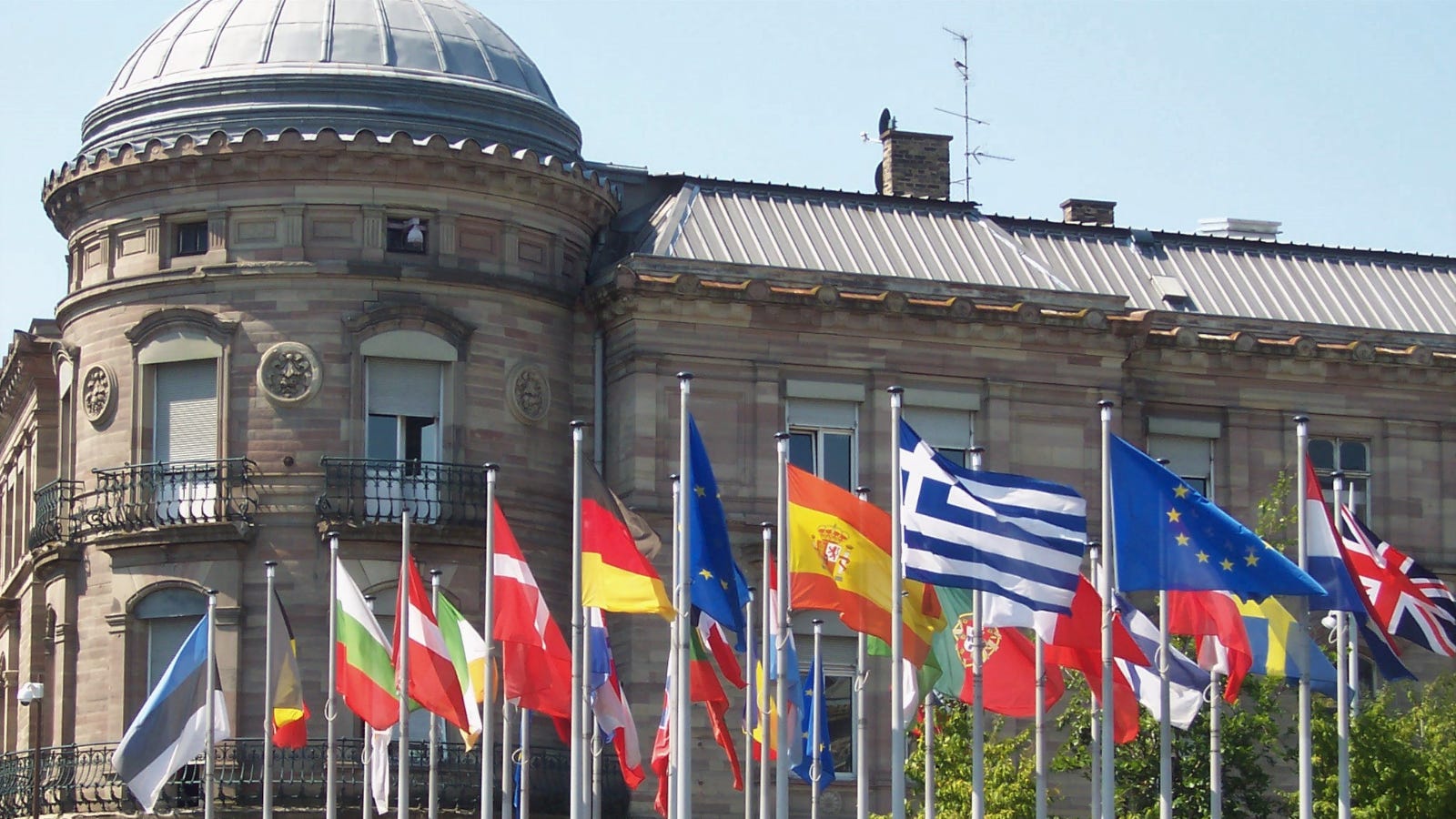
There is, however, one place on this planet where Europeans are artificially created as an observable social group: Brussels. This is one of the most dangerous aspects of the European Union. In Brussels, the institutions of the EU create, through the social dynamics of a shared workplace, the same kind of community that every workplace produces. People work in the same buildings, get annoyed by the same janitor, go to the same bars after work, and attend the same company parties and receptions. This community is very much cross-party and cross-factional and plays a decisive role in the domestication of fundamental political opposition by parliament. But the phenomenon itself is not limited to Brussels. I was recently at the parliament of the German state of Rhineland-Palatinate, and there is a “Landtagsgrieche” there, a Greek restaurant frequented by members of all parliamentary groups simply because it is a two-minute walk from the parliament. What is specific to Brussels, however, is the tendency to mistake this community of co-workers for a continent-wide sense of belonging shared by all Europeans. No member of a national parliament confuses the bar counter in the parliamentary cellar with the nation in this way.
Does the non-existence of Europe as an identity distinguishable from the West therefore imply eternal Nibelung loyalty to Washington? Because that is, let us be honest, the driving force behind all these right-wing Europeans: They want an alternative to the transatlantic alliance. They did not wake up one morning filled with brotherly love for the French and the Poles.
The answer to this question depends on how one interprets the political tendencies of our time. If we are entering an era of civilizational states, then our civilizational state would be the Western one, and its undisputed hegemon the United States of America. On this thesis, I side with Wilhelm Hankel, who remarked that according to this logic there would only be dinosaurs left, and all the lizards would have gone extinct. Political sovereignty can remain with the nation-state, even though intellectuals have been predicting its demise for more than a hundred years. In view of the looming mass extinction of obsolete political forms, I would rather be a lizard than a dinosaur.
When the German Empire was unified in 1871, some Bavarians would have preferred to retain an independent Bavaria. One may consider that right or wrong; it was a possible position. A united Germany consisting of Bavaria, Baden, the Rhineland, and Hamburg against Prussia would have been an absurdity, and as such it was only founded in 1949. But such an absurdity is an anti-Western, anti-American Europe. Not even culture, that much-invoked concept, would gain from it. Reduce European culture to everything that Europeans have in common with one another but not with Americans. What would remain? Brigitte Bardot and soccer. That would not be that much.